(Excerpt from a previously published report on using social media to forecast the 2018 Brazilian Presidential Election, Analyzing the 2018 Brazilian Election Social Media Influence Index, July 2018)
Betting / Prediction Markets
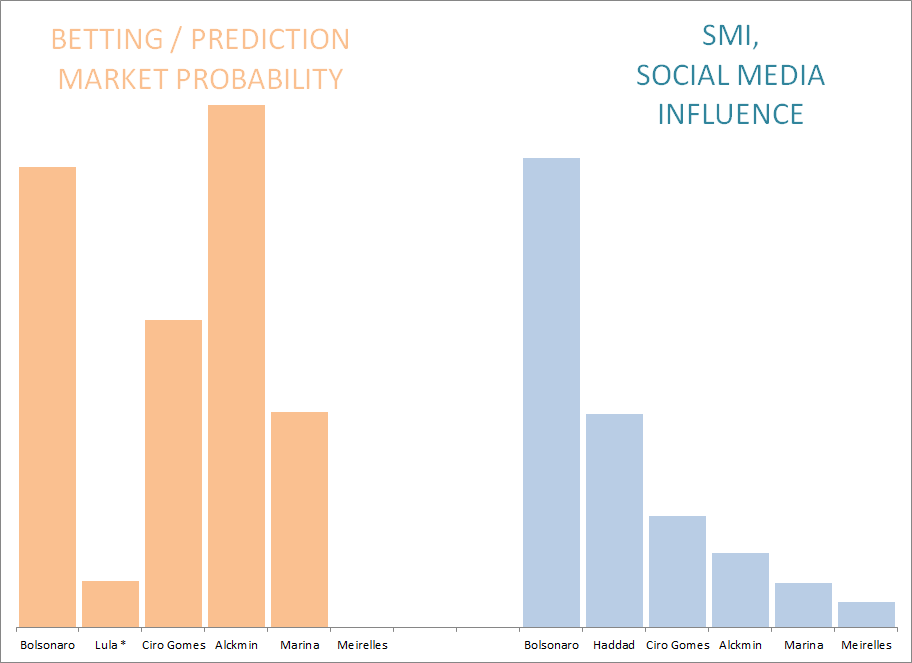
In addition to polls, many analysts follow prediction or betting markets. These markets offer participants the opportunity to bet on outcomes of different events, including elections. They often follow poll trends tightly, but at times, such as in the case of Brazil, they vary considerably. Additionally, prediction markets often seem to diverge with SMI forecasts. A comparison between SMI and prediction market probabilities is shown below.
Exhibit 3: Prediction Market Probability versus Social Media Influence, for principal candidates in 2018 Brazilian Presidential Election
Source: Predictit, Zettacap * Lula is used as a proxy for Haddad here, as there is no contract for Haddad
Prediction markets put Bolsonaro at a very similar level as SMI. However, outside of Bolsonaro, there is little in common between these two groups of forecasts.
Lula is shown as having very poor chances in prediction markets. In reality, the chances of Lula getting out of jail and winning the election do seem extremely remote at this point. Interestingly, Haddad is not provided as an option on Predictit, the prediction site used, so we assume there is little demand for a betting contract of him winning. In short, betting markets place a very limited chance of the PT performing well in this election. This is in contrast to polls and SMI which both place PT candidates in the top two, depending on a number of scenarios of who is running.
Ciro Gomes performs well in prediction markets. In fact, of the left-leaning candidates, prediction markets have him as the strongest. There is a solid argument as to why he might be considered the left’s best chance during this election. The PT is currently in chaos and its brand has been hit by a series of national scandals, which could leave many doubting a PT candidate performing well in the 2018 election.
However, even with Lula’s blessing, it seems like a stretch to forecast Gomes winning. Gomes has already run for president on two separate occasions and both times just barely cracked double-digits. Adjusting polls for high undecided figures would push Gomes to around what he received in previous elections. In other words, he seems to have a ceiling somewhere in the low double digits (11% or 12%), which is not enough to get him very far. Additionally, his SMI puts him around that same level, which confirms that the true support for Gomes is far from surging. It would take all of the left to rally around him in the election for Gomes to have a real shot.
The real surprise in the prediction markets is the strength of Alckmin. He is the leading candidate! This is totally unforeseen in SMI and polls – both of which have him as a weak candidate who is not gaining traction. And, these figures appear even worse once you take into consideration he already ran once for president and is from the PSDB, one of the largest and most well-backed parties in Brazil. Essentially, the PT and PSDB have been the dominating political parties in Brazil since 1994. With the PT in shambles, you would assume that Brazilians would turn to the PSDB for stability. But, Alckmin simply does not inspire – not in polls or on social media. He just seems like an average low-risk candidate in an environment that requires some excitement. A country in economic and social crisis needs an inspired candidate. This current election simply does not seem to be one where an electorate will simply settle for the low-risk candidate.
Seemingly, the prediction markets are betting that Brazilians will rush to Alckmin as the low risk option. This seems plausible from an analyst’s perspective. It makes sense as a scenario and he, as well as his party, is certainly prepared to administer. In reality, however, this scenario looks increasingly less probable. We are less than three months from the first round of voting and Alckmin has not made much progress in terms of polls or SMI. He has been stuck, for the most part, in the single digits in the polls. There are a few polls, over the past year, which show him in the very low double digits but he seems to have peaked around 11%. And, the trend has been down since the beginning of the year. His SMI is even worse, forecasting more weakness in polls and not the expected surge inferred by prediction markets.
From a SMI perspective, the largest error currently existing in the prediction markets is its over-estimation of the strength of Alckmin.
Marina’s chances seem a bit excessive as well, but not as much as that of Alckmin. Marina’s prediction market probability is considerably higher than both her SMI and poll figures. It is understandable how analysts could see her winning as a possibility. Her current polls place her in a strong third place position. Plus, she has performed well in the two previous presidential elections, even leading polls for a short time in one of them. She is likeable, paints herself as non-establishment and even has elements that fit on the left and right of the political spectrum. SMI, however, shows her as not gaining traction. A fairly consistently weak SMI has dragged her chances down for about the last year. She just does not seem to be able to generate a critical mass of influence on social media to be considered a front-runner.
